A cheaper pump is not always a cheaper fill
A station advertising fuel for a few pence less may cost more to reach than it saves at the pump. FillUp starts with that everyday decision: for the amount of fuel you want to buy, and the car you drive, is the extra journey worthwhile?
FillUp is a free UK beta from 42Analytics. It needs no account. It combines the official Fuel Finder feed with road routing and a deterministic cost calculation, showing the assumptions and dates behind each comparison.
This is an independent product engineering project. It does not claim measured savings across its users or guaranteed coverage of every station.
Give each source a clear job
The updater checks complete station and price snapshots from the official API approximately every five minutes. A separate hourly check reads the official CSV for missing station details. API prices remain authoritative within the application: CSV details supplement gaps, with their source and observation or publication dates preserved.
Before importing a snapshot, the updater validates it. Missing or duplicate station identifiers, incomplete downloads and inconsistent records must not silently become a new successful update. Comparison requests read the saved snapshot; they do not fetch prices from the provider for every visitor.
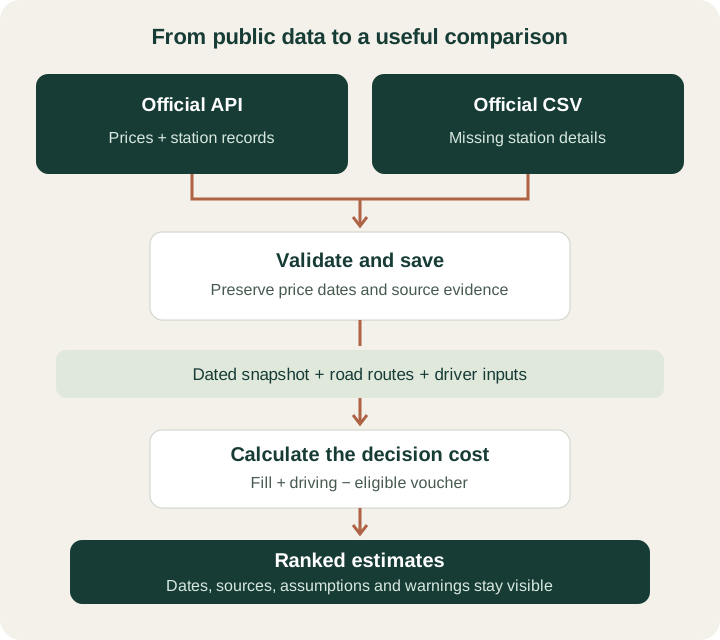
This separation keeps ingestion, routing and calculation independently testable. It also makes a source failure visible without confusing it with a driver's search.
Count the driving that belongs to the decision
For a nearby fill-up, the comparison adds the purchase cost to the estimated fuel used travelling there and back. The current return estimate doubles the outward route, so one-way systems and asymmetric return journeys are a limitation.
For a stop on a longer journey, FillUp compares the route through each station with the direct journey. Only the additional distance and driving time count towards the fuel-stop decision. A shorter alternative route does not earn a negative driving-cost credit.
Fuel economy is entered in UK MPG. Drivers can optionally value their time and apply a qualifying voucher. The same candidates and routes are used for the before-and-after voucher comparison, so the discount's effect is inspectable. A lower pump price does not automatically produce the lowest total.
The map can show the route through the selected station alongside the direct journey. Drivers can open directions in Google Maps with that station as a stop; Google may choose a different route or travel time.
A recent observation is not a recent price confirmation
Three different questions matter: when the retailer supplied a price, when FillUp observed that reading, and when the feed was last checked successfully. Refreshing the feed must not reset an old price's age.
Prices more than 30 days old are excluded by default. Drivers can explicitly include them, with age warnings. Stations with missing closure flags remain eligible with a prominent unconfirmed-status warning; reported closures are excluded. CSV fallback details do not erase an unconfirmed API closure warning.
These labels are part of the result. A precise-looking total is only useful when the driver can understand the evidence behind it.
Monitor the comparison, not just the homepage
A page can load while the service behind its main button is failing. FillUp therefore has an external test comparison alongside service and memory checks.
An alert on 28 October exposed a sequence of failed feed checks. The service paused comparisons when its successful check became too old. We adjusted retry timing for transient failures and made alert messages include the HTTP status, while retaining snapshot validation and the 15-minute freshness cutoff. Failed downloads still cannot advance the successful-check timestamp.
Feedback also exposed slow desktop location requests. The interface now gives location lookup a bounded wait, offers a postcode alternative and displays a clear error. Reliability includes helping someone recover when a browser capability does not work.
What the estimate leaves out
Routing uses OpenStreetMap road data through OSRM. It does not model live traffic, queues, time spent filling, toll charges or other vehicle running costs. Opening hours and remaining tank range are not checked. Available routes and eligible reported prices limit the comparison; UK coverage is not a promise that every possible trip or retailer is supported.
FillUp is independent of government and carries the relevant open-data and mapping attribution. Reported prices can still be wrong or change before arrival. The displayed dates, sources and station warnings remain essential.
Where it fits
42Analytics builds systems that turn complex data into useful decisions. FishFacts applies that work to seafood-market intelligence; Strata explores historical well analogues. FillUp brings data engineering and transparent calculation to a familiar household expense.
The common thread is practical: make the inputs traceable, the reasoning inspectable and the limitations clear enough to act on.